
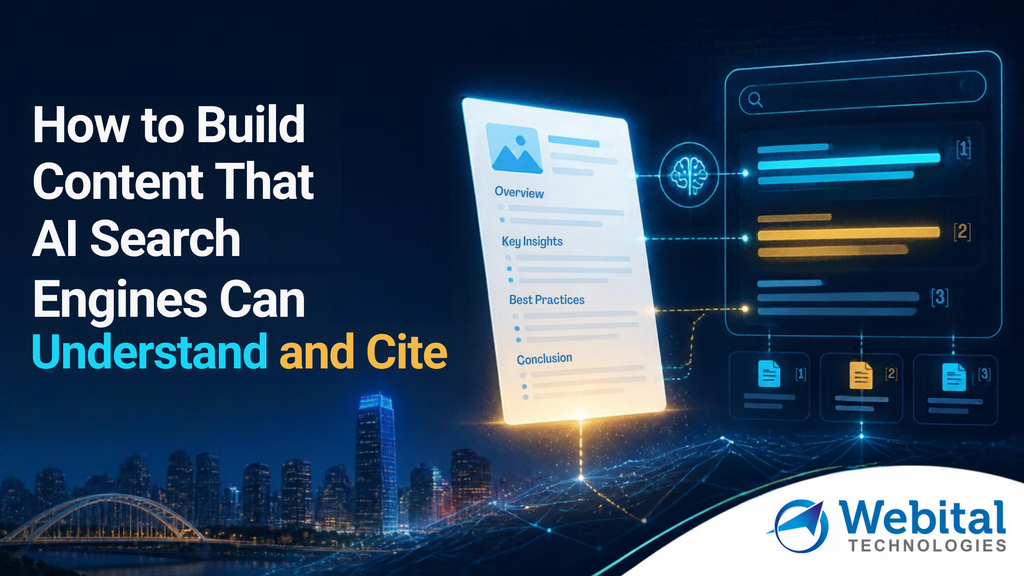
When people search for information online, they are no longer relying only on traditional search results. They may ask Google AI Overviews, Google AI Mode, ChatGPT, or other AI-powered tools to explain a topic, compare services, or recommend possible solutions.
These tools can present summaries and, depending on the platform and query, cite websites that support their answers. For businesses, this creates an important question: how can you create content that AI search engines can understand and potentially cite?
The answer starts with clear writing, useful information, credible evidence, and a website that search systems can access.
AI search content optimization is not about writing exclusively for machines. It is about publishing content that answers real questions, explains important concepts accurately, and makes supporting information easy to identify.
For Edmonton businesses, these practices can strengthen an existing SEO strategy while helping prepare website content for evolving search experiences.
What Does It Mean for AI Search Engines to Understand Your Content?
AI-powered search systems process information from different sources to respond to user questions. Depending on the platform, they may retrieve webpages, identify relevant passages, summarize information, and provide links or citations.
For your content to be useful in these experiences, its purpose and meaning should be clear.
For example, consider a digital marketing company that offers local SEO services.
A vague sentence such as “We help businesses grow online with innovative solutions” provides little detail about the service.
A more informative explanation would describe how local SEO helps eligible businesses improve their presence in relevant local search results through accurate business information, useful location-specific content, and appropriate website optimization.
The second explanation communicates a more specific idea and gives readers a clearer understanding of the service.
AI systems use their own processes to interpret and select information, so clear content does not guarantee citation. However, clarity makes the content more useful to people and easier to interpret.
Why AI-Understandable Content Matters in 2026
Search behaviour continues to evolve as users ask more detailed questions and explore AI-powered search features.
Instead of entering only a short keyword, a user might ask:
- How can a small business improve its local search visibility?
- What should I look for when choosing an SEO agency?
- How does generative engine optimization differ from traditional SEO?
- Which website improvements can help generate more qualified leads?
These questions require more than keyword repetition. They call for explanations, comparisons, practical advice, and reliable information.
Businesses that answer relevant questions thoroughly can create more useful resources for their audiences.
However, AI search visibility depends on several factors, including the platform, query, available sources, technical accessibility, and the relevance of competing information. No writing technique guarantees that an AI system will cite a particular website.
9 Ways to Create Content That AI Search Engines Can Understand and Cite
1. Start With a Specific Search Intent
Before writing an article, identify what the reader actually wants to accomplish.
Someone searching for “what is local SEO” needs a clear explanation. Someone searching for “how to choose an SEO company in Edmonton” is likely comparing providers and evaluating their options.
These searches require different content.
Start by asking:
- What question is the reader trying to answer?
- What information do they need to make a decision?
- What related questions might they have?
- What practical next step should the content support?
Then organize the article around those needs.
For example, a business researching website optimization may benefit from a guide explaining technical SEO, content improvements, internal linking, and performance measurement.
Your article should answer the main question early and then provide the supporting details readers need.
For additional guidance, read How to Choose an SEO Company in Edmonton.
2. Give Direct, Clear Answers Before Adding Detail
Readers should not have to search through several paragraphs to find the main point.
Start important sections with a concise answer, then explain the reasoning, examples, limitations, or steps involved.
For instance:
Question: What makes content easier for AI search systems to understand?
Clear headings, accurate information, descriptive language, logical organization, and accessible webpages can help systems interpret the subject and identify relevant information.
You can then explain how each element contributes to a better reading and search experience.
This approach also benefits human readers who scan articles to find specific answers.
However, do not turn every paragraph into a short answer just to target AI search. Detailed explanations are still necessary when a topic requires context.
3. Use Descriptive Headings and Logical Content Structure
Headings help readers understand what each section covers. They also make long articles easier to navigate.
Use one clear H1 for the main article title, H2 headings for major topics, and H3 headings for supporting sections where needed.
For example, an article about AI search optimization might use sections such as:
- What Is AI Search Optimization?
- How AI Search Systems Use Website Content
- How to Improve Content Structure
- Why Credible Sources Matter
- How to Measure AI Search Visibility
Each heading should accurately describe the content that follows.
Avoid vague headings that provide no useful context. Also, do not force keywords into every heading. Natural language is easier to read and helps maintain a clear article structure.
4. Make Your Information Specific and Verifiable
General statements often provide limited value because readers cannot easily determine what they mean or how to apply them.
Instead, explain your recommendations with relevant details, examples, and supporting evidence.
For example, rather than saying that website speed is important, explain which performance measurements a business can review and what those measurements indicate.
Google’s Core Web Vitals include three useful measures:
- Largest Contentful Paint (LCP), which measures how quickly the main content appears.
- Interaction to Next Paint (INP), which measures page responsiveness.
- Cumulative Layout Shift (CLS), which measures unexpected layout movement.
Google’s recommended good thresholds are LCP of 2.5 seconds or less, INP of 200 milliseconds or less, and CLS of 0.1 or less.
Specific information gives readers something practical to evaluate.
When making factual claims, use reliable sources and verify details before publication. For statistics, include the relevant timeframe and explain what the numbers measure. Never invent research findings, customer results, or expert quotations.
5. Demonstrate First-Hand Knowledge and Credibility
AI search optimization should not become an exercise in publishing large volumes of generic articles.
Content becomes more useful when it includes meaningful information that reflects real expertise and experience.
Depending on your business, this may include:
- Examples from completed projects.
- Lessons learned during implementation.
- Original research or observations.
- Genuine customer questions and answers.
- Clear explanations of your process.
- Relevant qualifications or professional experience.
- Limitations and circumstances where a recommendation may not apply.
For example, a website development company could explain how it evaluates a client’s existing website before recommending a redesign.
A specific, accurate explanation is more useful than a broad claim that the company delivers the best results.
Only publish experiences and results that your business can substantiate. Credibility comes from accurate information, not exaggerated claims.
6. Organize Important Information Into Readable Sections
Large blocks of text make it harder for readers to locate important details.
Break complex subjects into focused sections. Use numbered steps for processes, bullet points for related items, and tables only when comparing information is genuinely helpful.
When explaining a process, keep the steps in a logical order.
For example, a practical content optimization process might involve:
- Identifying the target audience and search intent.
- Reviewing existing content and identifying information gaps.
- Organizing the page around the main question.
- Verifying claims and adding useful supporting evidence.
- Checking internal links and technical accessibility.
- Measuring performance after publication.
This structure makes the process easier to follow without sacrificing detail.
You can also use relevant FAQs to address specific questions that the main article does not fully resolve.
Remember that formatting alone does not make content citation-worthy. The information itself must be useful and relevant.
7. Build Context Through Relevant Internal Links
Internal links connect related pages on your website. They help visitors discover more information and provide context about how different topics relate to one another.
For example, an article about AI search content can link to a page explaining generative engine optimization. A guide about content structure may link to a relevant resource about AI-friendly website design.
Readers exploring this topic can learn more through Generative Engine Optimization Edmonton.
You can also link to AI-Friendly Website Design in Edmonton when discussing website structure, accessibility, and technical foundations.
Use descriptive anchor text that tells readers what the destination covers. Make sure every linked page is relevant to the surrounding discussion.
Avoid adding links simply to increase their number. A smaller set of useful, contextual links is preferable to a long list of unrelated destinations.
8. Make Sure Search Engines Can Access Your Content
Even excellent content may struggle to appear in search results if important pages cannot be crawled or indexed.
Review the technical foundations of your website before focusing exclusively on content formatting.
Check that:
- Important pages return the correct HTTP status codes.
- Search engines are not unintentionally blocked from accessing key content.
- Canonical tags identify the intended version of a page.
- Internal links point to working destinations.
- Important information is available in accessible page content.
- Mobile layouts work correctly.
- The website does not rely entirely on content that search systems cannot readily access.
Use Google Search Console to inspect indexing and review search performance.
For websites that need broader technical improvements, SEO Services Edmonton can be a relevant starting point for exploring professional optimization support.
There is no requirement to create a special AI-only version of every webpage. Focus on a technically sound website that serves users and follows established search guidelines.
9. Keep Content Accurate and Updated
Outdated information can undermine a page’s usefulness, especially when it discusses changing technology, software features, policies, pricing, or industry statistics.
Review important articles periodically.
During each review, check:
- Whether the information remains accurate.
- Whether referenced tools or features have changed.
- Whether examples still reflect current practices.
- Whether links work correctly.
- Whether new questions deserve an answer.
- Whether the content still matches its intended search intent.
Update an article when meaningful changes improve its accuracy or usefulness. Changing the publication date without making substantive improvements does not make the content better.
For topics involving AI search, distinguish established platform guidance from speculation and predictions. This helps readers understand which recommendations are supported and which remain uncertain.
How to Structure an Article for Better AI Search Understanding
A useful article structure does not need to be complicated.
Consider this outline for a blog about local SEO:
H1: How Local SEO Helps Businesses Reach Nearby Customers
Introduction: Explain the business problem and what the article will cover.
H2: What Is Local SEO?
Provide a clear definition and explain its purpose.
H2: How Does Local SEO Work?
Describe relevant activities, such as maintaining accurate business information and creating useful service pages.
H2: Which Local SEO Improvements Should Businesses Prioritize?
Present practical steps and explain when each step is useful.
H2: How Can Businesses Measure Progress?
Discuss relevant metrics, including search visibility, website visits, phone calls, and qualified enquiries.
H2: Frequently Asked Questions
Answer relevant questions that readers may still have.
Conclusion and CTA: Summarize the practical takeaway and offer an appropriate next step.
This structure helps readers navigate the article and keeps related information together. It does not guarantee that AI systems will select individual passages, but it creates a more coherent resource.
Does FAQ Schema Help AI Search Engines Cite Your Content?
FAQ content can improve a page’s usefulness when it answers genuine customer questions. Appropriate structured data may also help search engines interpret eligible content.
However, there is an important distinction between writing FAQs and using FAQ schema.
Adding FAQ schema does not guarantee rich results, AI citations, or improved rankings. Google has also restricted FAQ rich results primarily to well-known, authoritative government and health websites.
For most business websites, the priority should be accurate answers, useful page structure, and a good visitor experience. Implement structured data only when it accurately describes the visible content and complies with the relevant platform’s guidelines.
How SEO, AEO, and GEO Work Together
Creating content that AI search systems can understand involves several related practices.
Search Engine Optimization (SEO)
SEO helps search engines discover, understand, and present relevant pages. It includes technical accessibility, content quality, internal linking, and satisfying search intent.
Explore SEO Services in Edmonton for more information about organic search optimization.
Answer Engine Optimization (AEO)
AEO focuses on making information useful for systems that provide direct answers to questions.
Clear definitions, relevant headings, concise explanations, and helpful supporting details can improve the reader’s experience. However, no particular format guarantees selection by an answer engine.
Learn more about Answer Engine Optimization Edmonton.
Generative Engine Optimization (GEO)
GEO focuses on the discoverability and potential use of content in generative AI search experiences.
Useful information, verifiable claims, relevant context, and accessible webpages can support this objective. Still, citations depend on how individual systems retrieve, evaluate, and present sources.
Explore Generative Engine Optimization Edmonton.
These approaches overlap. Businesses can start by creating genuinely helpful content, maintaining a technically accessible website, and measuring how their audience discovers and uses their information.
Common Content Mistakes That Can Reduce Your Content’s Value
Some content practices create unnecessary problems for both readers and search performance.
Keyword stuffing: Repeating the same phrase excessively makes articles awkward and distracts from the actual question.
Publishing generic AI-generated articles: Content that repeats widely available information without adding value may give readers little reason to choose your website.
Making unsupported claims: Unverified statistics, exaggerated results, and fabricated expertise damage credibility.
Using vague headings: Headings should explain the section’s subject rather than rely on clever but unclear wording.
Creating unnecessary pages: Publishing multiple pages that target almost identical queries can introduce duplication without improving the information available to readers.
Ignoring technical accessibility: Search systems need to be able to access important content for it to be considered for search results.
Promising guaranteed AI citations: No content writer or optimization agency can guarantee that a specific AI platform will cite a particular webpage.
A more sustainable approach is to prioritize usefulness, accuracy, and technical quality over shortcuts.
How to Measure Whether Your AI Search Content Strategy Is Working
AI search visibility can be difficult to measure because different platforms provide different reporting capabilities.
Rather than relying on a single metric, use several sources of evidence.
Monitor Traditional Search Performance
Google Search Console can help you evaluate impressions, clicks, click-through rates, and average search positions for eligible Google Search data.
Review the queries and pages that attract relevant visitors. Look for opportunities to improve content that receives impressions but does not generate meaningful engagement.
Review Website Traffic and Conversions
Use your analytics platform to understand which landing pages attract visitors and whether those visits lead to enquiries, calls, bookings, or sales.
A page with fewer visits may still provide business value if it attracts highly qualified prospects.
Monitor Referral Traffic Where Available
Some AI platforms may send referral traffic that can be identified in analytics reports.
Track these visits where possible, but recognize that not every AI-assisted discovery will appear as a measurable referral.
Evaluate Content Quality Regularly
Review whether your articles answer their intended questions, provide accurate information, and guide readers toward useful next steps.
You can also test relevant questions across AI search tools to understand how they currently present information about your topic. Treat these observations as snapshots rather than proof of guaranteed future visibility.
The goal is to improve the quality and usefulness of your content while measuring outcomes your business can verify.
Final Thoughts
Creating content that AI search engines can understand and cite begins with the same principle that makes good content valuable to people: provide clear, accurate, and genuinely useful information.
Start with a specific search intent. Answer the main question directly, organize supporting details logically, verify factual claims, and connect related pages through relevant internal links. Then make sure your website is technically accessible and monitor performance over time.
For Edmonton businesses, these practices can strengthen an existing SEO strategy while preparing content for changing search experiences.
No format, schema, or optimization technique guarantees an AI citation. However, a helpful and credible website gives readers more reasons to trust your business and gives search systems useful information to evaluate.
Frequently Asked Questions
1. How do I make content easier for AI search engines to understand?
Use clear language, descriptive headings, logical sections, accurate facts, and relevant examples. Answer the main question directly and ensure search engines can access the page.
2. How can I get my website cited by AI search engines?
Publish useful, original, and credible information that directly addresses relevant questions. Maintain good technical SEO and provide supporting evidence where appropriate. Citation selection depends on the platform and query, so no method guarantees inclusion.
3. Does AI-generated content rank in search engines?
AI-assisted content can appear in search results when it is useful, relevant, and meets applicable search requirements. Google emphasizes content quality and value rather than whether AI was used to produce it. Publishing unhelpful content at scale to manipulate rankings can violate its spam policies.
4. Do headings help AI search systems understand content?
Descriptive headings help readers navigate a page and communicate how its information is organized. They can support content understanding, but headings alone do not guarantee rankings or citations.
5. Is FAQ schema necessary for AI search optimization?
No. FAQ schema is not a universal requirement for AI search visibility. Useful answers, accurate content, technical accessibility, and appropriate structured data are more important than adding markup simply for AI.
6. What is the difference between AEO and GEO?
AEO focuses on content that helps answer questions directly. GEO focuses on improving content’s discoverability and potential use in generative AI responses. Both overlap with traditional SEO and benefit from useful, accessible information.
7. How often should I update content for AI search?
Review important pages regularly, especially when they cover changing technology or industry information. Update content when you can improve its accuracy, relevance, or usefulness rather than changing dates without substantive revisions.
Ready to Improve Your Content Strategy?
Your content should help customers understand your services, answer their questions, and make informed decisions.
Webital Technologies helps businesses explore SEO, answer engine optimization, generative engine optimization, and website development strategies tailored to their goals.
Contact the team to discuss how your website content can better support organic search visibility and customer enquiries.
Webital Technologies
- Phone: (825) 343-0927
- Email: webitaltechnology@gmail.com
- Address: #209 4104A 97 Street Northwest, Edmonton, AB T6E 5Y6
Contact Webital Technologies to discuss your SEO and AI search optimization goals.