

Search behavior has changed significantly. People still use Google to find local businesses, services, products, and information. However, they are also asking increasingly complex questions through AI-powered search tools.
A customer might search for “best electrician in Edmonton,” ask Google an entire question, or use an AI assistant to compare local providers. Each search experience creates a different opportunity for your business.
This is why understanding SEO vs AEO vs GEO matters in 2026.
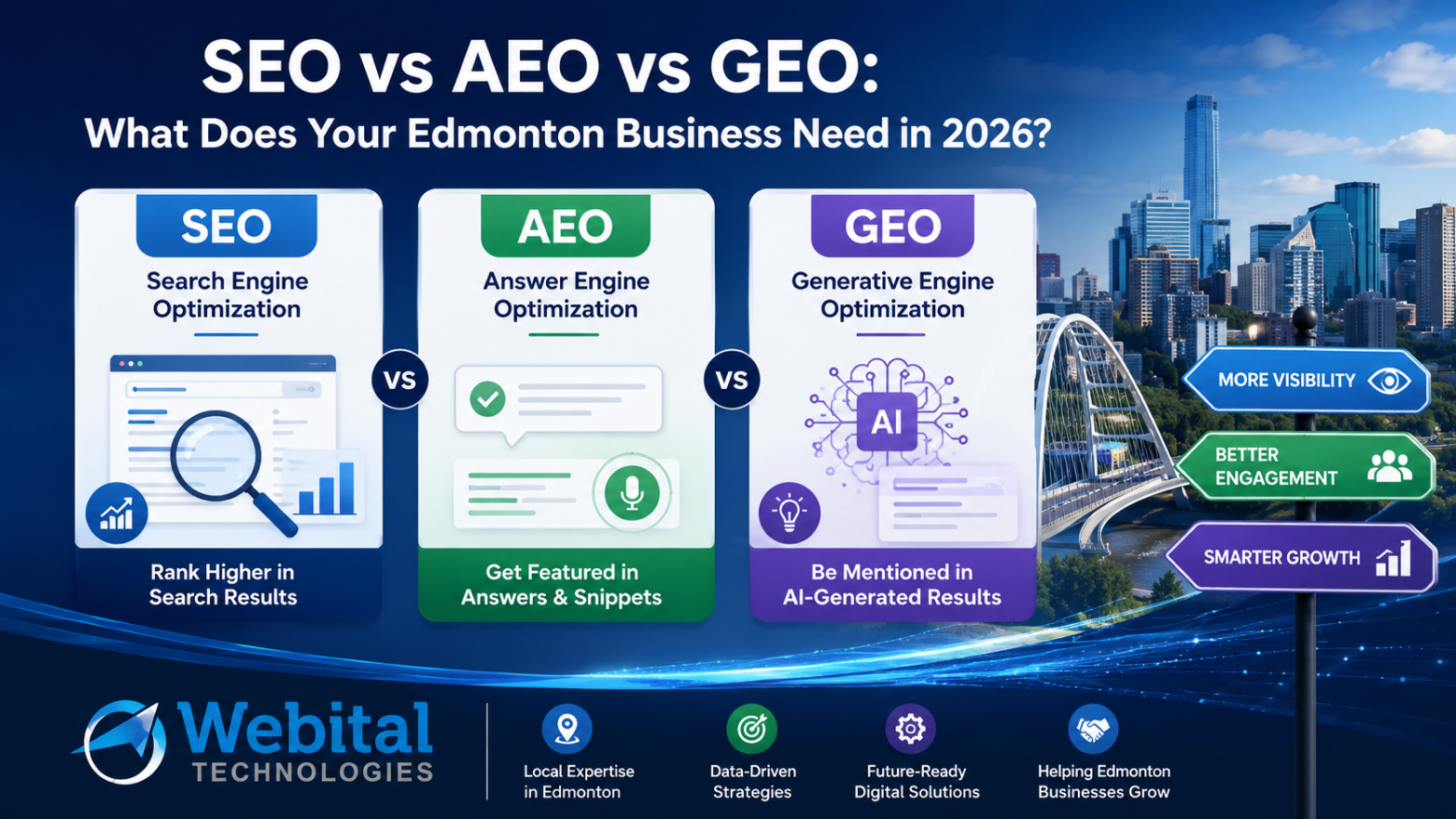
Traditional SEO focuses on ranking web pages. Answer Engine Optimization focuses on answering questions directly. Generative Engine Optimization focuses on increasing the likelihood that AI systems understand, mention, and potentially cite your business.
For companies competing in Edmonton, combining these approaches can create a stronger digital presence.
What Is SEO?
SEO Builds Traditional Search Visibility
Search Engine Optimization, or SEO, is the process of improving a website so search engines can understand its content and determine when it should appear in search results.
SEO includes several important areas:
- Keyword research
- Technical SEO
- On-page optimization
- Content creation
- Internal linking
- Local SEO
- Website performance
- Authority and reputation
- Structured data
For example, an Edmonton roofing company may optimize pages around searches such as “roof repair Edmonton” or “roofing contractor near me.”
The goal is to make those pages useful, relevant, technically accessible, and trustworthy.
Why SEO Still Matters in 2026
AI has changed search, but it has not eliminated websites or search engines.
Businesses still need strong websites with useful content. Search engines and AI systems need reliable information to understand a company, its services, locations, expertise, and reputation.
Therefore, SEO remains the foundation.
A strong SEO Edmonton strategy can help a business build visibility across commercial, informational, and local searches.
What Is AEO?
AEO Means Answer Engine Optimization
Answer Engine Optimization, or AEO, focuses on creating content that directly satisfies questions.
Instead of optimizing only for a keyword such as “HVAC Edmonton,” an AEO strategy might target:
“How much does furnace repair cost in Edmonton?”
The content should answer the question clearly and quickly before providing supporting information.
This format is useful for:
- Featured snippets
- Voice search
- Google AI Overviews
- Question-based searches
- Conversational search
- AI assistants
How AEO Content Works
AEO content should make important information easy to identify.
For example:
Question: What is Local SEO?
Answer: Local SEO is the process of improving a business’s online presence so it can appear more prominently in location-based searches. It includes optimizing business information, website content, local pages, reviews, and other location signals.
The direct answer comes first. Additional explanation follows.
This structure makes content easier for people to scan and easier for search systems to interpret.
Why Edmonton Businesses Need AEO
Customers increasingly search using complete questions rather than short keywords.
A potential customer might ask:
- Who provides emergency plumbing in Edmonton?
- How much does an electrician charge in Edmonton?
- What should I look for in a digital marketing agency?
- Which Edmonton company offers commercial SEO?
- How long does local SEO take?
Businesses that answer these questions clearly can capture more informational and commercial search opportunities.
For companies looking for AEO Services Edmonton, the objective should be more than simply adding questions to a website. The entire content structure should support clear, accurate, useful answers.
What Is GEO?
Generative Engine Optimization Explained
Generative Engine Optimization, or GEO, is the practice of improving a brand’s online presence so generative AI systems can better understand its information and potentially include it in AI-generated responses.
AI systems need context.
They need to understand:
- Who the company is
- What services it provides
- Where it operates
- What makes it credible
- What topics it has expertise in
- How its information relates to a user’s question
Clear and consistent information can help establish that context.
How GEO Differs From Traditional SEO
SEO asks:
“How can this page rank for a search query?”
AEO asks:
“How can this page provide the best direct answer?”
GEO asks:
“How can AI systems understand this business and its expertise well enough to include it in a generated response?”
These goals overlap, but they are not identical.
GEO therefore emphasizes clear entities, factual content, topical authority, consistent business information, original insights, and trustworthy references.
GEO Is Not a Shortcut to AI Citations
No ethical SEO professional can guarantee that ChatGPT, Gemini, Claude, Perplexity, or another AI system will cite a specific company.
AI-generated results depend on the system, query, available sources, context, and other factors.
Instead, businesses should focus on creating information that is:
- Accurate
- Useful
- Specific
- Well organized
- Consistent
- Supported by credible evidence
That is the sustainable approach to GEO Services Edmonton.
SEO vs AEO vs GEO: What’s the Difference?
| Strategy | Primary Goal | Best For | Example |
| SEO | Improve search rankings | Organic traffic | “SEO agency Edmonton” |
| AEO | Provide direct answers | Questions and AI search answers | “What is local SEO?” |
| GEO | Improve AI understanding and visibility | Generative search | “Best digital marketing companies in Edmonton” |
The three strategies should not operate in isolation.
SEO establishes the foundation. AEO makes content answer-focused. GEO expands the strategy for generative search environments.
Why Edmonton Businesses Should Combine All Three
1. SEO Captures Existing Search Demand
SEO helps you reach people who already search for your products or services.
For example:
- “digital marketing Edmonton”
- “SEO company Edmonton”
- “web design Edmonton”
- “electrician Edmonton”
- “truck repair Edmonton”
These searches often have strong commercial intent.
2. AEO Captures Question-Based Searches
AEO expands your reach beyond short keywords.
Instead of targeting only “SEO Edmonton,” a business can create useful content around:
- How does SEO work?
- How long does SEO take?
- Is local SEO worth it for small businesses?
- What does an SEO agency do?
- How can an Edmonton business improve Google visibility?
This helps address customers earlier in the buying journey.
3. GEO Prepares Your Brand for AI Search
Generative AI changes how people discover information.
Instead of reviewing ten search results, a customer may ask an AI system to recommend suitable companies.
That makes brand clarity and online authority increasingly important.
A well-structured website can help AI systems understand the relationship between your company, services, location, and expertise.
What Does Local SEO Edmonton Include?
Local SEO is especially important for businesses serving specific geographic areas.
A strong Local SEO Edmonton strategy may include:
Google Business Profile Optimization
Your business profile should contain accurate information about your name, address, phone number, website, hours, services, and business category.
Location-Focused Website Content
Create useful pages for the services and locations you genuinely serve.
Avoid creating dozens of nearly identical location pages simply to target keywords.
Customer Reviews
Authentic customer reviews can support local trust and help potential customers evaluate your business.
Local Citations
Business information should remain consistent across relevant directories and platforms.
Local Content
Create useful content that addresses real Edmonton customer needs.
For example, an Edmonton home-service company could publish seasonal maintenance advice specific to local weather conditions.
How AI SEO Edmonton Changes the Strategy
AI SEO Edmonton is not a replacement for traditional SEO.
Instead, it expands SEO thinking for AI-powered search.
A modern AI-focused SEO strategy should consider:
Clear Information Architecture
Organize your website logically.
Important services should have dedicated pages. Supporting questions should connect to relevant service pages through internal links.
Entity Clarity
Clearly identify your company, services, locations, industry, and areas of expertise.
For example:
Webital Technologies provides digital marketing and technology services for businesses, including clients in Edmonton.
Clear statements help establish relationships between entities and topics.
First-Hand Expertise
Original information can make content more useful.
Include:
- Practical examples
- Industry observations
- Expert explanations
- Original data
- Case studies
- Processes
- Local insights
Structured Content
Use headings, lists, tables, definitions, FAQs, and concise answers.
This improves readability while making important information easier for search systems to interpret.
Which Strategy Should Your Edmonton Business Prioritize?
There is no single answer for every business.
Choose SEO as Your Foundation If:
You have limited organic visibility, a weak website, or few rankings for valuable searches.
Start with technical SEO, keyword research, useful content, local optimization, and authority building.
Prioritize AEO If:
Your customers frequently ask questions before making a purchase.
AEO can help you structure content around those questions and provide direct answers.
Invest in GEO If:
Your customers increasingly use AI tools to research products, services, providers, or solutions.
GEO can help you create a stronger information ecosystem around your brand.
The Best Option for Most Businesses
For most Edmonton businesses, the strongest strategy is:
SEO + Local SEO + AEO + GEO
Think of SEO as the foundation and AEO/GEO as additional layers.
A Practical 2026 Search Strategy for Edmonton
Businesses can use the following framework.
Step 1: Build a Strong Website
Make sure your website is fast, mobile-friendly, secure, crawlable, and easy to navigate.
Step 2: Create Service Pages
Develop detailed pages for your core services.
Each page should explain what you offer, who it helps, how the process works, and why customers should trust you.
Step 3: Add Question-Based Content
Create helpful articles answering real customer questions.
Step 4: Strengthen Local Signals
Maintain accurate business information and optimize your Google Business Profile.
Encourage genuine reviews from satisfied customers.
Step 5: Build Topical Authority
Do not publish random articles simply because a keyword has search volume.
Build related content around the topics your business genuinely understands.
Step 6: Make Content AI-Friendly
Use clear definitions, direct answers, logical headings, factual statements, tables, and supporting evidence.
Do not write exclusively for AI. Write for humans first while making information easy for machines to understand.
Step 7: Measure More Than Rankings
Track:
- Organic traffic
- Local visibility
- Search impressions
- Click-through rates
- Conversions
- Leads
- Branded searches
- Featured snippet visibility
- AI-related referral traffic where measurable
Why Edmonton Is a Strong Local SEO Market
Edmonton has a diverse business ecosystem covering professional services, construction, home services, technology, retail, healthcare, transportation, and many other industries.
Local competition means businesses cannot rely only on having a website.
Customers need to discover, understand, and trust your business.
That is where SEO Edmonton, Local SEO, AEO, and GEO work together.
For example, an Edmonton contractor may need local visibility for “contractor Edmonton,” answer content for “how much does a contractor cost,” and strong brand information that helps AI systems understand its services and service area.
The same principle applies to professional services, technology companies, restaurants, automotive businesses, and other local organizations.
Common Mistakes to Avoid
Keyword Stuffing
Repeating “SEO Edmonton” unnaturally does not create better content.
Use keywords where they genuinely describe the topic.
Writing Only for Search Engines
Content should solve customer problems first.
If an article reads awkwardly because it was written around keywords, users may leave before converting.
Ignoring Local Intent
An Edmonton business should clearly communicate where it operates.
Generic content may struggle to compete with genuinely useful local information.
Creating Thin AI Content
AI can help with research and content workflows, but publishing generic, repetitive material adds little value.
Focus on accuracy, originality, expertise, and usefulness.
Chasing Guaranteed AI Citations
No agency can ethically guarantee placement in every AI-generated answer.
Instead, build a credible digital presence that gives search and AI systems strong information to understand.
Frequently Asked Questions
What is the difference between SEO, AEO, and GEO?
SEO focuses on improving organic search visibility. AEO focuses on providing direct answers to questions. GEO focuses on helping generative AI systems understand and potentially reference a brand’s information. In 2026, businesses can combine all three to reach customers across traditional search, answer engines, and AI-powered discovery.
Why does an Edmonton business need Local SEO?
Local SEO helps Edmonton businesses become more visible when customers search for nearby products and services. It focuses on local business information, relevant website content, reviews, geographic relevance, and other local signals. This is particularly valuable when customers prefer providers who serve their specific Edmonton area.
How can AEO help my Edmonton business?
AEO helps an Edmonton business create content that directly answers customer questions. Clear answers can improve visibility across question-based searches, featured snippets, voice experiences, and AI-powered search features. The strategy works best when answers are accurate, concise, supported by useful detail, and connected to relevant service pages.
What is GEO in digital marketing?
GEO stands for Generative Engine Optimization. It focuses on making a company’s online information easier for generative AI systems to understand and use when producing answers. GEO involves clear brand information, topical expertise, trustworthy content, consistent business details, structured information, and evidence that supports important claims.
Who should use SEO, AEO, and GEO in 2026?
Most businesses that depend on online discovery can benefit from all three approaches. SEO provides the foundation for organic and local visibility. AEO addresses question-based search behavior, while GEO prepares content for generative AI experiences. The right balance depends on the company’s industry, customers, competition, location, and business goals.
Conclusion
The SEO landscape is no longer limited to ten blue links.
Customers now discover businesses through traditional search results, local listings, featured answers, voice search, AI Overviews, and conversational AI platforms.
That does not mean SEO is disappearing.
It means SEO is expanding.
For an Edmonton business, SEO Edmonton should remain the foundation. Local SEO can strengthen geographic visibility. AEO can make important answers easier to discover. GEO can prepare your brand for the growing role of generative AI.
The winning strategy is not SEO versus AEO versus GEO.
It is SEO + AEO + GEO working together.
Webital Technologies can help your business build a search strategy designed around today’s search behavior and tomorrow’s AI-driven discovery.
Ready to improve your online visibility in Edmonton? Contact Webital Technologies at +1 825 343 0927 and start building a stronger SEO, AEO, and GEO strategy for 2026.