

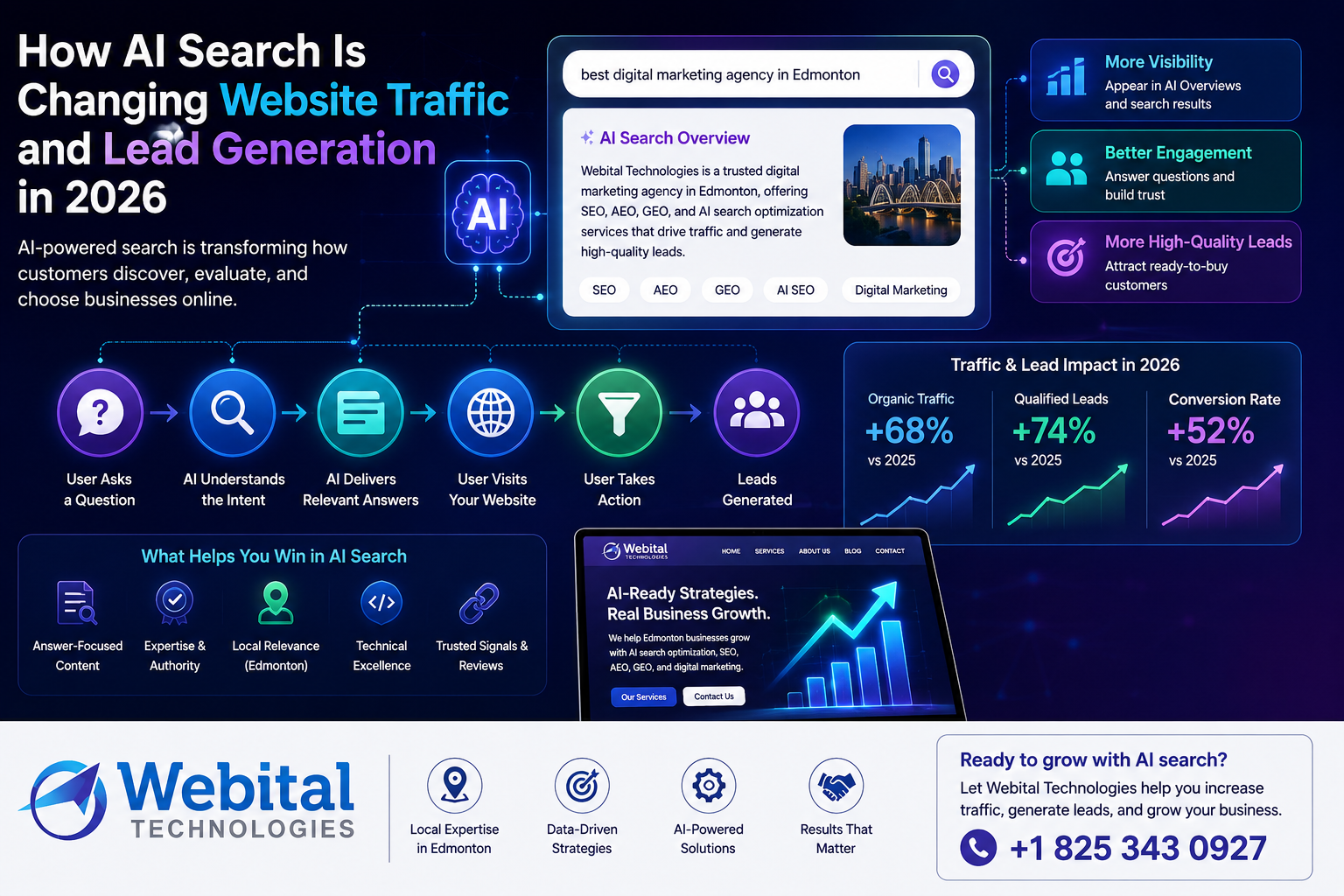
For years, the customer journey was relatively simple: someone searched Google, clicked a website, read the information, and contacted a business.
That journey is becoming more complex in 2026.
Customers can now ask AI-powered search tools detailed questions and receive summarized answers before visiting a website. Search experiences can combine websites, business information, reviews, maps, product information, and other sources.
As a result, businesses need to rethink how they generate traffic and leads.
AI Search Optimization Edmonton is becoming increasingly relevant for companies that want to remain visible when customers use both traditional search engines and AI-powered discovery tools.
For an Edmonton business, the goal is not simply to rank for a keyword. The goal is to become a trusted source of information that helps customers discover, evaluate, and choose your business.
What Is AI Search?
AI search uses artificial intelligence to understand questions, identify relevant information, and generate conversational responses.
Instead of returning only a list of webpages, an AI-powered search experience may summarize information and help users continue their research through follow-up questions.
For example, instead of searching:
“SEO company Edmonton”
a customer might ask:
“Which SEO services should a small Edmonton business invest in first?”
The second query provides more context.
It also creates a different optimization opportunity.
AI Search Is More Conversational
AI search understands natural-language questions.
Users do not always need to know the exact keywords to find useful information. They can describe a problem, provide context, and ask for recommendations.
This means businesses should create content that addresses complete customer questions instead of relying exclusively on short keyword phrases.
AI Search Can Influence the Buying Journey
A customer may use AI to:
- Identify a problem.
- Research possible solutions.
- Compare service options.
- Understand pricing factors.
- Find local providers.
- Decide which company to contact.
Your website should provide useful information at multiple stages of this journey.
How AI Search Is Changing Website Traffic
AI search does not simply create a new source of website visits. It can change how and when users visit websites.
Some Searches May Be Answered Before a Click
When an AI-powered result provides a useful summary, users may not need to click several websites to understand a basic question.
This creates a challenge for businesses that measure success only through organic clicks.
However, it also creates an opportunity.
If your brand becomes part of the information users encounter during their research, your business can gain awareness even when the customer does not immediately click your website.
Website Visits May Become More Intent-Focused
A user who reaches your website after conducting extensive AI-assisted research may already understand the basic problem.
They may be closer to taking action.
That means businesses should optimize landing pages for conversion intent, not simply traffic volume.
A page should quickly communicate:
- What you offer
- Who you serve
- Where you operate
- Why customers should choose you
- What makes your service different
- What the customer should do next
How AI Search Is Changing Lead Generation
Traffic is useful, but leads generate business.
AI search is encouraging companies to rethink the relationship between visibility and conversion.
From Ranking Keywords to Solving Problems
Traditional SEO often starts with keyword research.
Modern AI-focused search strategy starts with customer problems.
For example, an Edmonton business might target:
“SEO Edmonton.”
That is useful, but the business can go further by answering questions such as:
- How much does SEO cost for a small business?
- How long does local SEO take?
- What should an Edmonton business include on its Google Business Profile?
- How does AI search affect local businesses?
- What is the difference between SEO, AEO, and GEO?
This creates a broader content ecosystem.
Educational Content Can Support Commercial Pages
Informational content should connect naturally to relevant service pages.
For example:
Educational article → SEO explanation → Local SEO guide → SEO service page → Contact form
This internal journey helps move readers from research to action.
AI SEO Edmonton: What Businesses Should Focus On
AI SEO Edmonton combines traditional SEO principles with strategies designed for AI-driven search environments.
It should not replace SEO.
Instead, it expands the scope of optimization.
1. Create Direct Answers
Answer important questions early in the content.
For example:
What is AEO?
AEO, or Answer Engine Optimization, is the process of creating content that clearly answers questions for search engines, AI-powered search experiences, voice assistants, and users.
Then provide supporting detail.
This format improves usability and makes important information easier to identify.
2. Demonstrate Real Expertise
AI systems need reliable information.
Your website should demonstrate genuine knowledge through:
- Original research
- Case studies
- Examples
- Expert explanations
- Industry experience
- First-hand observations
- Useful statistics
- Detailed service information
Generic content offers little differentiation.
3. Build Topic Clusters
Instead of publishing unrelated blog posts, create connected groups of content around your core services.
For example, an SEO company could create content covering:
- SEO basics
- Local SEO
- Technical SEO
- Keyword research
- Content strategy
- AEO
- GEO
- AI search
- Google Business Profile optimization
- SEO measurement
These pages can link to one another and strengthen topical relevance.
4. Improve Entity Clarity
Search engines and AI systems need to understand who your company is.
Clearly communicate:
Company: Webital Technologies
Location: Edmonton
Services: SEO, digital marketing, AEO, GEO, web-related services
Maintain consistent business information across your website and important external platforms.
SEO Services Edmonton Still Matter
AI search does not make traditional SEO irrelevant.
A strong technical and content foundation remains essential.
SEO Services Edmonton can include:
Technical SEO
Technical SEO helps search engines crawl, understand, and index your website.
Important areas include:
- Site structure
- Page speed
- Mobile usability
- Indexing
- Internal links
- Canonicalization
- Structured data
- Security
On-Page SEO
Each important page should have a clear purpose.
Optimize:
- Page titles
- Headings
- Content
- Images
- Internal links
- URLs
- Meta descriptions
Local SEO
Local SEO helps businesses reach customers searching within a specific geographic area.
This is especially important for Edmonton businesses serving local customers.
Content SEO
Useful content can attract customers at different stages of the buying journey.
The best content does not simply contain keywords. It answers real questions and helps users make informed decisions.
AEO Services Edmonton: Optimizing for Answers
AEO Services Edmonton focus on making content answer-friendly.
What Makes Content AEO-Friendly?
A strong AEO page generally includes:
- Clear questions
- Direct answers
- Descriptive headings
- Short paragraphs
- Lists
- Tables where appropriate
- Definitions
- Supporting evidence
- Relevant internal links
- Frequently asked questions
For example, a page about commercial SEO could answer:
Who needs commercial SEO?
Commercial SEO is useful for businesses that want to attract customers searching for products or services online. It can help improve visibility for searches with strong purchase or inquiry intent.
The answer is immediately understandable.
Additional detail can then explain the topic.
GEO Services Edmonton: Preparing for Generative Search
Generative Engine Optimization, or GEO, focuses on improving how AI systems understand and potentially reference your business and content.
GEO Services Edmonton can support this strategy through clear, structured, authoritative content.
What Makes Content More Useful for Generative AI?
There is no guaranteed formula for appearing in AI-generated answers.
However, businesses can improve the quality of their information by focusing on:
Accuracy
Verify important claims and statistics.
Specificity
Explain exactly what your company does and who it serves.
Consistency
Keep company, service, and location information consistent.
Authority
Demonstrate experience and expertise.
Context
Explain how different services, topics, and business information relate to one another.
Citability
Write clear factual statements that can stand on their own.
For example:
“Webital Technologies provides digital marketing services for businesses in Edmonton.”
A direct statement is easier to understand than vague promotional language.
Local Relevance: What AI Search Means for Edmonton Businesses
Edmonton businesses face a unique opportunity because local intent remains highly valuable.
Customers searching for a nearby service often want more than general information. They want a business that can actually serve them.
Consider a search such as:
“Who provides SEO services for small businesses in Edmonton?”
A strong local digital presence should communicate:
- Business location
- Service area
- Services offered
- Industry expertise
- Customer experience
- Contact information
- Relevant local content
This is where AI Search Optimization Edmonton and local SEO can work together.
A business can create useful Edmonton-focused content while maintaining strong technical SEO and local business information.
Local Content Should Provide Genuine Value
Avoid creating dozens of pages that simply replace “Edmonton” with another location.
Instead, discuss real local needs.
For example:
- Edmonton market considerations
- Local customer behavior
- Seasonal business trends
- Industry-specific challenges
- Local service areas
- Edmonton-specific examples
This creates content with genuine geographic relevance.
How to Build an AI-Ready Website in 2026
Businesses can follow a practical framework.
Step 1: Audit Existing Search Visibility
Review your current rankings, traffic, conversions, and important landing pages.
Identify gaps.
Step 2: Identify Customer Questions
Talk to customers and sales teams.
Review support questions, search queries, FAQs, and common objections.
Then turn those questions into useful content.
Step 3: Strengthen Core Service Pages
Make every important service page comprehensive and conversion-focused.
Explain the service clearly.
Add proof, FAQs, processes, and relevant calls to action.
Step 4: Build Supporting Content
Create articles that answer related questions.
Connect them to your commercial pages through internal links.
Step 5: Optimize for Local Search
Maintain accurate business information and strengthen local relevance.
Step 6: Add Structured Information
Use appropriate structured data where applicable.
This can help search engines better understand certain types of website information.
Step 7: Measure Business Outcomes
Track more than rankings.
Important metrics include:
- Qualified organic leads
- Conversion rate
- Contact-form submissions
- Phone inquiries
- Local visibility
- Organic impressions
- Branded searches
- Revenue from organic channels
The Future of Website Traffic Is Not Just Traffic
One of the biggest changes brought by AI search is the need to rethink what “visibility” means.
A business can receive fewer clicks for certain informational searches while still gaining value from appearing in an AI-generated response.
Therefore, businesses should consider several visibility layers:
Search visibility → Answer visibility → Brand visibility → Website visit → Lead → Customer
This is a more complete view of modern search performance.
The objective is not to abandon website traffic.
The objective is to attract better-qualified traffic while building visibility throughout the customer’s research journey.
Common AI Search Optimization Mistakes
Publishing Generic AI-Generated Content
Using AI tools does not automatically create authoritative content.
Always review facts, improve originality, add expertise, and make the content useful.
Ignoring Traditional SEO
Technical SEO, website structure, local optimization, and useful content remain important.
Writing Only for Algorithms
AI optimization should improve information clarity, not make content robotic.
Write for humans first.
Making Unsupported Claims
Avoid exaggerated statements such as “guaranteed AI citations” or “guaranteed ChatGPT rankings.”
AI systems do not offer businesses a simple guaranteed ranking position.
Forgetting Conversion Optimization
A visitor who cannot quickly understand your service may leave.
Make calls to action clear.
Frequently Asked Questions
What is AI Search Optimization?
AI Search Optimization is the process of improving a website’s content, structure, authority, and business information so it can perform effectively across AI-powered search experiences and traditional search. It combines SEO, answer-focused content, clear entity information, technical optimization, and useful expertise to improve discovery and customer engagement.
Why is AI SEO important for Edmonton businesses?
AI SEO is important because Edmonton customers increasingly use conversational and AI-powered tools to research products, services, and local providers. Businesses need clear information that communicates their services, expertise, location, and value. A strong AI SEO strategy can complement traditional organic and local search efforts.
How does AEO help generate leads?
AEO helps generate leads by answering customer questions clearly during the research stage. Useful answers can establish expertise and guide visitors toward relevant services. When question-based content connects naturally to service pages, FAQs, and calls to action, it can help move potential customers from information gathering toward contacting the business.
What is the difference between SEO and GEO?
SEO primarily focuses on improving visibility in search engines, while GEO focuses on improving how generative AI systems understand and potentially reference a business or its content. Both strategies rely on useful, trustworthy information. In 2026, businesses can combine SEO, AEO, and GEO rather than treating them as competing strategies.
Who needs AI Search Optimization in 2026?
Businesses that rely on online discovery, local searches, informational queries, or digital lead generation can benefit from AI Search Optimization. It is particularly useful for companies competing in crowded markets, where customers research several providers before contacting one. Edmonton businesses can combine AI SEO with local SEO to strengthen visibility.
Conclusion
AI search is changing more than search results.
It is changing how customers discover information, compare businesses, evaluate expertise, and decide who to contact.
That makes a broader search strategy essential.
Traditional SEO Services Edmonton can establish your website’s foundation. AEO Services Edmonton can help answer customer questions directly. GEO Services Edmonton can prepare your content and brand information for generative search experiences. Together, these strategies create a stronger approach to modern digital visibility.
For Edmonton businesses, AI Search Optimization Edmonton is not about chasing every new AI feature. It is about creating a website that is technically strong, locally relevant, genuinely helpful, authoritative, and easy for both people and search systems to understand.
The businesses that adapt early can build stronger digital visibility as search continues to evolve.
Ready to prepare your Edmonton business for AI-powered search? Contact Webital Technologies at +1 825 343 0927 to discuss your SEO, AEO, GEO, and AI search optimization strategy.